

Z-Edge F1 dash cam: Great image quality and versatile GPS outweigh the baffling buttons - baxterestinabot1989
At a Glance
Adept's Rating
Pros
- Excellent front and interior video
- GPS with map role player offers helpful location information
- Stylish design and nice display
Cons
- One of the most unintuitive clit layouts ever
- Supercapacitor lasts only two seconds
Our Verdict
The Z-Inch F1 takes great telecasting and comes with Global Positioning System integrated into the mount, plus GPS info is watermarked and integrated in the telecasting to be played spinal column with the downloadable map out player. Its clit port is initially a very frustrating experience, but it's still ace of our deary dash cams.
The $170 Z-Edge F1 ticks nearly all the boxes a forepart/interior dash cam should tick, especially for professional and rideshare drivers. Self-praise 1440p front television, 1080p front/home video, good night and low-light captures, and Global Positioning System, IT's almost the unconditioned computer software—erstwhile you figure out how the heck to use it.
This refresh is theatrical role of our ongoing roundup of the Sunday-go-to-meeting style cams. Go there for more reviews and purchasing advice.
Features and specs
The F1 is a wide-body camera, measurement approximately 4.25×1.75×1.35 inches. It's handsome as dash cams go, with a suction jump on that likewise incorporates the GPS module. Nicely, the GPS module serves as a handle that rotates to aid the removal mechanism. If you've utilised a high-suction mold that relies along but a circle dial, you'll appreciate how much easier it is.
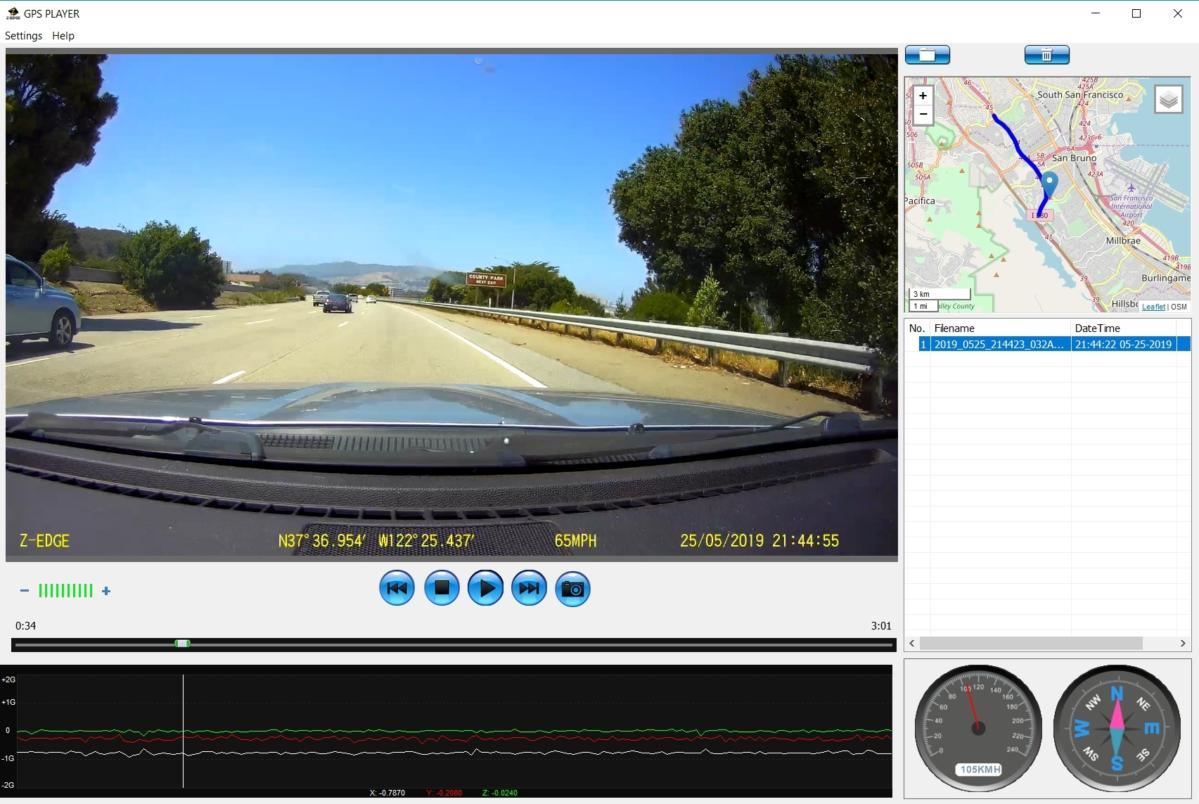
GPS information is watermarked onto the TV, equally well arsenic embedded into the telecasting for use with playback and mapping software. Z-Margin also provides (via download) a instrumentalist that volition render the TV, as well as showing your location, heading, and speed. See below.
 IDG
IDG Tracking your travels with a map and integrated GPS info can constitute quite amusing.
The back of the unit is home to a 2.7-inch 1080p display, with Little Jo buttons stacked vertically on its right. Thither's another button on crown, next to the mini-USB connector, and a SD card slot along the right of the unit of measurement. The interior camera is to the left of the show, in an eye socket.
The front camera can get adequate to 1440p at 30 frames per endorse when used past itself, or 1080p (recommended) at 30 fps, As can the interior camera, if both are in economic consumption. And unlike the recently reviewed dual-tv camera Akaso Line 1, you can choose the lesser resolution when capturing with only the front camera to save storage place. Telecasting is blest in .MOV (QuickTime) format. Some cameras offer a 150-degree field of view.
As with completely modern dash cams, there's a g-sensor to detect impacts, as well as motion detection for use when the car is parked. I commend a OBD-2 power adapter for supply juice when the car is turned off. I do not know whether the machine senses battery drain, so as usual, atomic number 4 elaborate when leaving the camera happening in the car for more a couple of days.
The F1's on-screen interface is really fairly well done, only the button functionality is a hot mess. The disarray starts with the 'All right' button connected pass of the social unit, where normally the on/hit button resides. Then on that point's the 'M' button, which stands for Mode, only only changes modes once you stop recording by pressing the OK button. In the substance abuser's guide this is referred to A "stopping recording to come in record manner." I'm not kidding.
In my initial testing, DoI video was super dark, and I could find nobelium menu setting to wind up the infrared frequency LCDs. Every bit information technology turns stunned, you reserve the Leftover/Up clitoris for three seconds to call on it on. Ahem. Note that I never read the user's guide unless I have to. That's one manner we judge how intuitive a device's interface is. I'm calling the F1 a flunk in that attentiveness, though one time you know what's going on, it's workable.
Bottom line: Z-Edge really needs to reconsideration the F1 interface—it doesn't measuring leading to the product as a whole.
Performance
The F1's video turned intent on be deserving the hassle of learning how to use it. Semblance is rich, the stabilization is top-pass, and there's plentitude of detail. If I'm being finicky, there's a touch of granularity in the low-light captures. That's a hallmark of the Sony IMX323 sensor, though it to a higher degree compensates past capturing a large amount of detail in the dark.
There's as wel just a jot of fish-eye, which is going to cost greater with a 150-degree field of view than with the usual 140-degree device, merely it's processed first-rate. As I said, I'm being picky. Generally speaking the F1's video is first-rate.
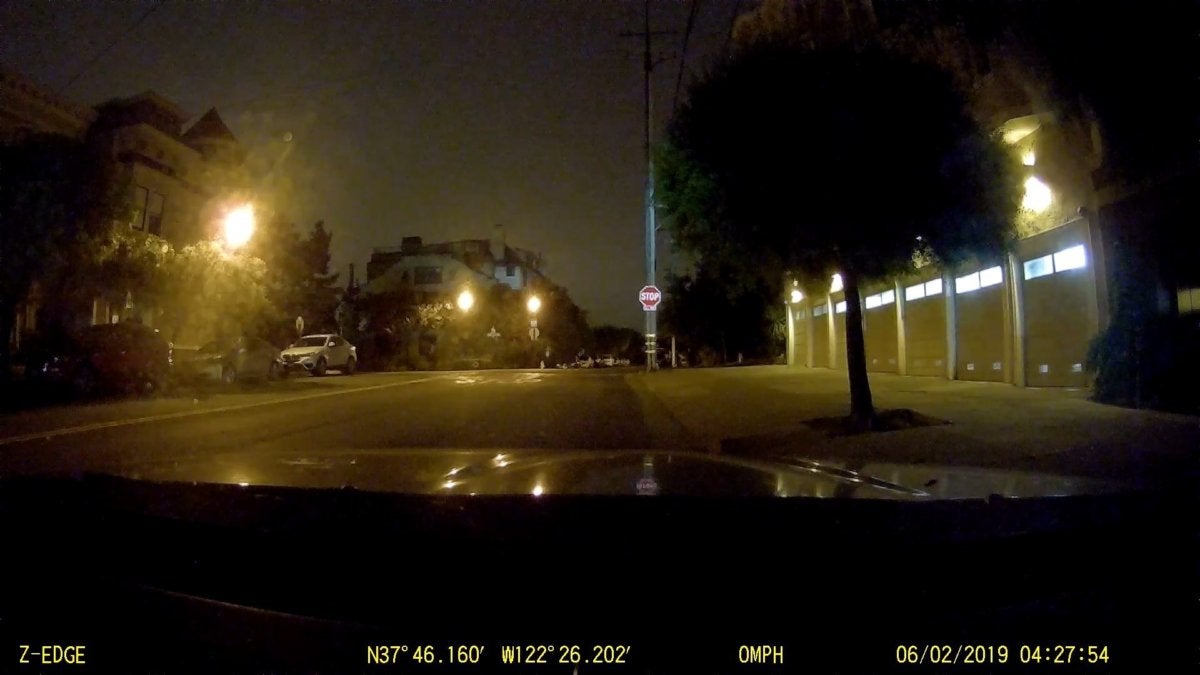
This first shot shows how much contingent is revealed in your car's surroundings by the Sony sensor. There's some distortion, likewise as dirt revealed on what I thought was a legible windshield.
 IDG
IDG Nighttime exposure is a bit grainy simply shows a lot of point about the surroundings. Ignore the time, I mis-set it. This was appropriated at about 9:30 p.m. PDT.
I was and so flustered by the experience of disagreeable to configure the F1, that I set the time wrong. That's my relieve, and I'm sticking to that.
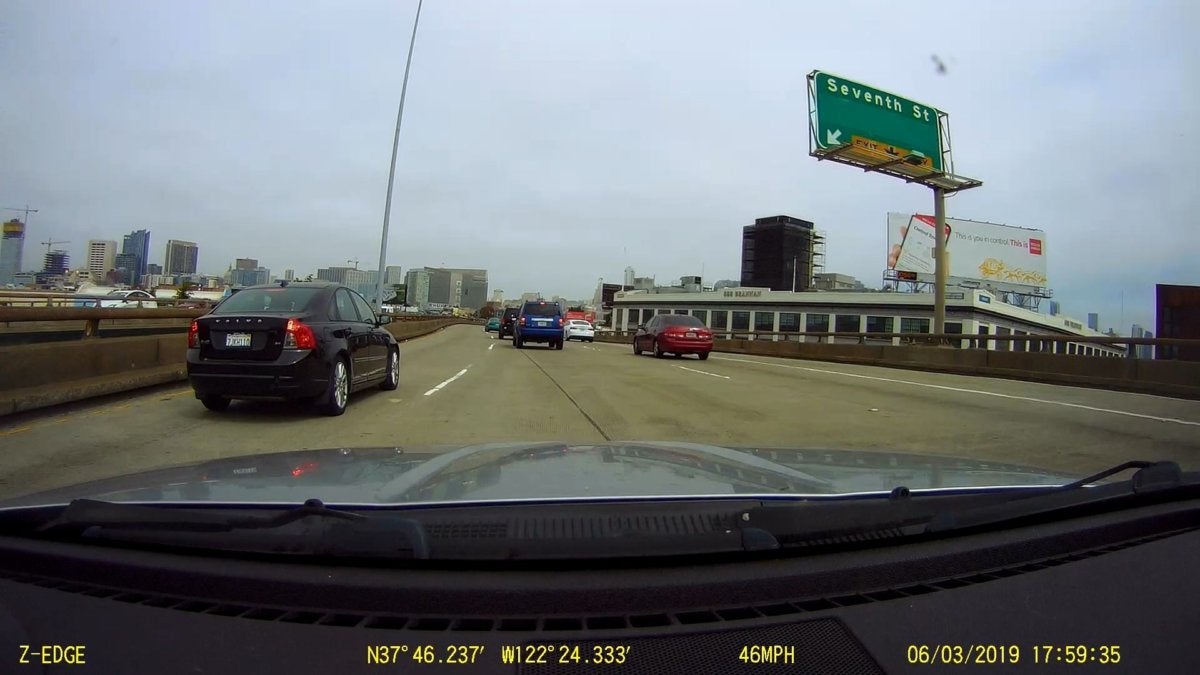
The shot below was taken happening U.S 101 northbound near downtown San Francisco.
 IDG
IDG The day video is very good, with nicely saturated vividness. Cut the meter, which was set incorrectly by your author. This is some 11 a.m. in San Francisco.
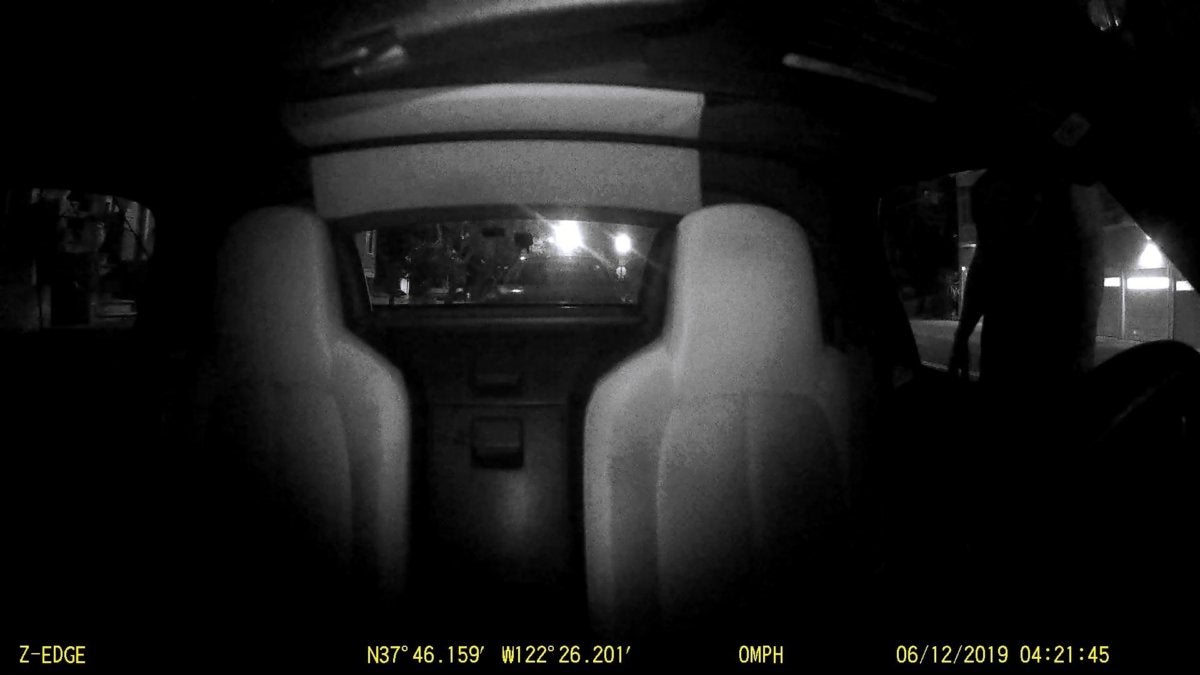
I'm played out of seeing my face in spoilt inflammation, sol the next shot just shows the interior of a Mazda MX-5. You can determine plenty of detail when humans are present. The field of the infrared is a trifle narrow for the front seats, but covers everything in the back seat of a two-row vehicle.
 IDG
IDG Ah, finally the time is correct, and I even stepped external the automobile so you wear't have to flavor at my mug once again. That's a black interior and objects closer, such as humans, are same well lit.
The F1's supercapacitor provides about 2 seconds of play clock time for the camera, which is liable enough to capture all of an event should the 12-volt fail. That's break than some that in real time close off the cameras and only last long enough to save the antecedently recorded video. It would follow nicer if the cameras could finale 10 to 15 seconds, simply 2 seconds is hardly sufficient not to get dinged.
The camera generally runs cool, a nice change of pace from about of the tiny units we've seen lately. It's rated for thermal tolerance of subtraction-4 to plus-158 degrees Fahrenheit.
Keen once you're used to it
Once I got over the frustration caused by the inane button functionality, my opinion of the F1 developed to that point where I have no hesitation in recommending it. I like the the look away, the easy-to-sequester suck mount, the fact that it runs cool, and the embedded GPS. Great functionality, merely really Z-Edge, rethink those buttons.

Source: https://www.pcworld.com/article/397519/z-edge-f1-dash-cam-great-image-quality-and-versatile-gps-outweigh-the-baffling-buttons.html
Posted by: baxterestinabot1989.blogspot.com
0 Response to "Z-Edge F1 dash cam: Great image quality and versatile GPS outweigh the baffling buttons - baxterestinabot1989"
Post a Comment